

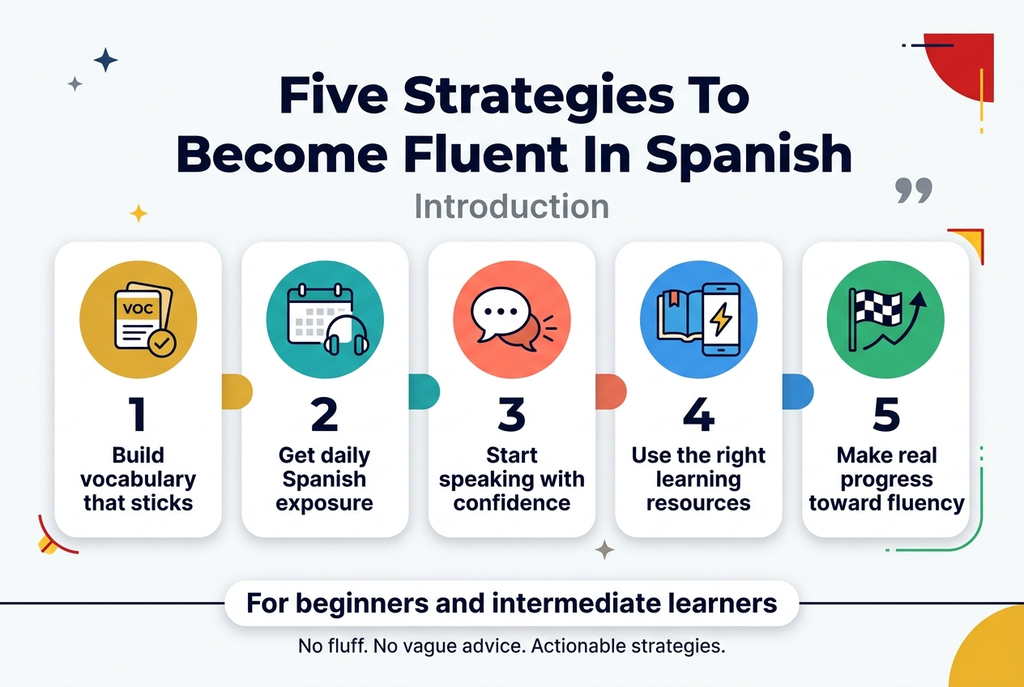
Five Strategies To Become Fluent In Spanish
Learning Spanish doesn’t have to feel like a chore you keep pushing to next week. If you’re someone who has started and stopped language apps more times than you can count, or you’ve been studying for months but still freeze up when a native speaker talks to you, this guide is for you.
Here, you’ll get five real, actionable strategies to become fluent in Spanish — no fluff, no vague advice. You’ll learn how to build a vocabulary that actually sticks, how to get daily Spanish exposure without overhauling your entire schedule, and how to start speaking with confidence even before you feel “ready.” You’ll also see how the right learning resources can cut your progress time down significantly.
These strategies work whether you’re a total beginner or someone who already knows the basics but can’t quite cross the finish line into fluency. Let’s get into it.
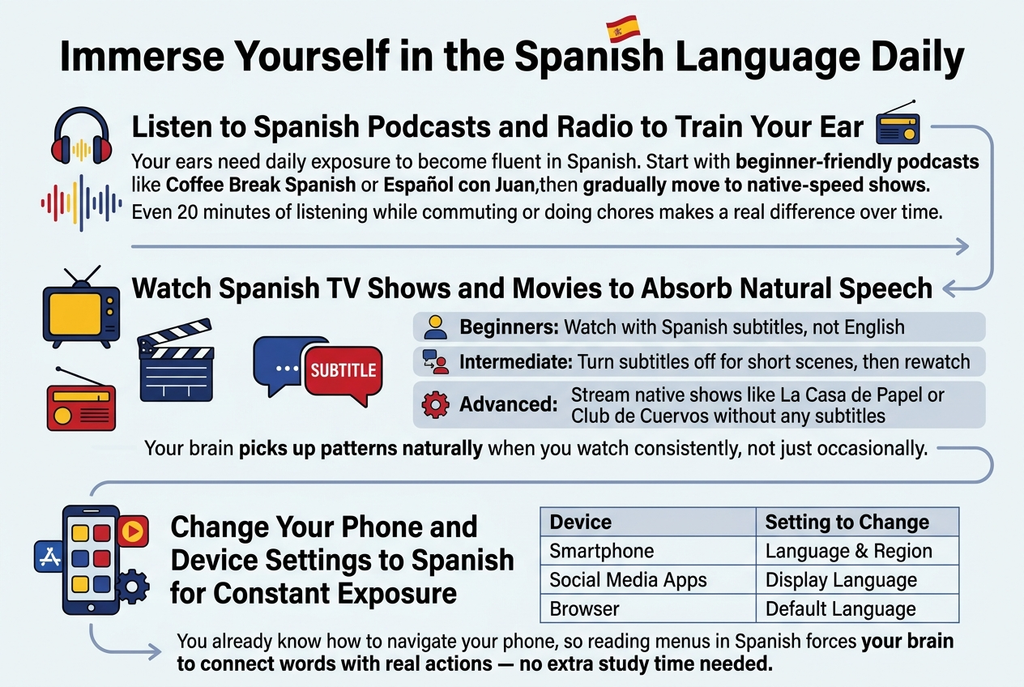
The First Strategy To Become Fluent In Spanish Is To Immerse Yourself in the Spanish Language Daily.
Listen to Spanish Podcasts and Radio to Train Your Ear
Your ears need daily exposure to become fluent in Spanish. Start with beginner-friendly podcasts like Coffee Break Spanish or Español con Juan, then gradually move to native-speed shows. Even 20 minutes of listening while commuting or doing chores makes a real difference over time.
Watch Spanish TV Shows and Movies to Absorb Natural Speech
Watching Spanish content exposes you to real slang, regional accents, and conversational rhythms that textbooks miss. Try these approaches:
- Beginners: Watch with Spanish subtitles, not English
- Intermediate: Turn subtitles off for short scenes, then rewatch
- Advanced: Stream native shows like La Casa de Papel or Club de Cuervos without any subtitles
Your brain picks up patterns naturally when you watch consistently, not just occasionally.
Change Your Phone and Device Settings to Spanish for Constant Exposure
This one small tweak creates hours of passive learning every single day. Switch your:
| Device | Setting to Change |
|---|---|
| Smartphone | Language & Region |
| Social Media Apps | Display Language |
| Browser | Default Language |
You already know how to navigate your phone, so reading menus in Spanish forces your brain to connect words with real actions — no extra study time needed.
To get you moving toward learning Spanish, a powerful tool is right here to help you!
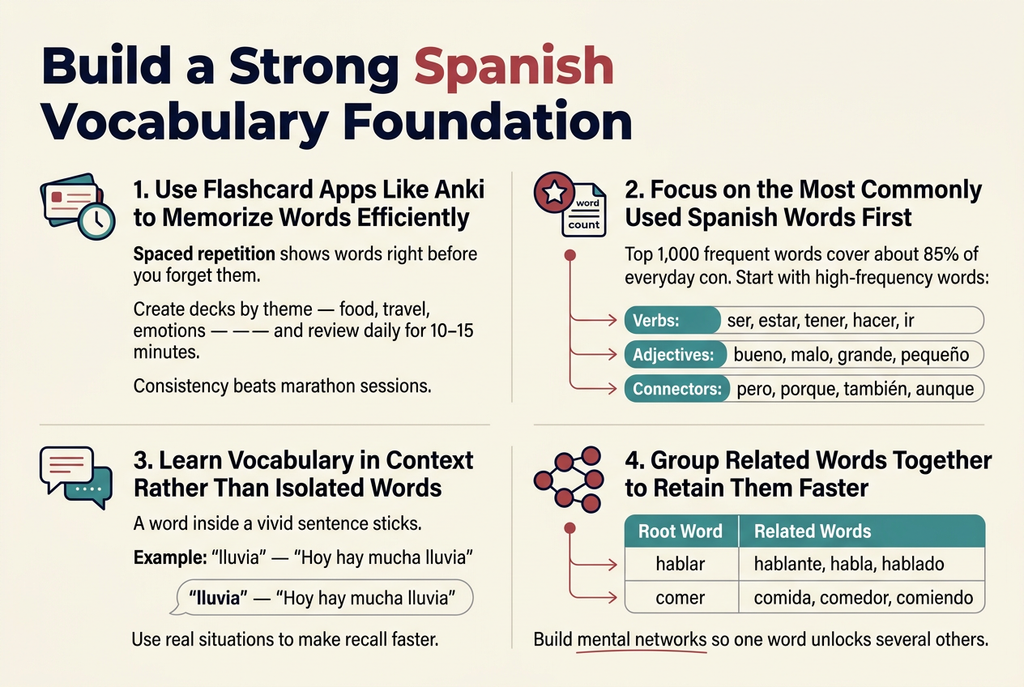
The Second Strategy To Become Fluent In Spanish Is By Building a Strong Spanish Vocabulary Foundation.
Use Flashcard Apps Like Anki to Memorize Words Efficiently
Anki uses spaced repetition to show you words right before you forget them, making your study time incredibly effective. Create decks organized by theme — food, travel, emotions — and review them daily for 10–15 minutes. Consistency beats marathon sessions every time.
Focus on the Most Commonly Used Spanish Words First
You don’t need every word in the dictionary to become fluent in Spanish. Mastering the top 1,000 most frequent Spanish words gives you roughly 85% of everyday conversation coverage. Start with high-frequency words like:
- Verbs: ser, estar, tener, hacer, ir
- Adjectives: bueno, malo, grande, pequeño
- Connectors: pero, porque, también, aunque
Learn Vocabulary in Context Rather Than Isolated Words
A word on its own is easy to forget. A word inside a vivid sentence sticks. When you learn lluvia (rain), pair it immediately with Hoy hay mucha lluvia (It’s very rainy today). Your brain connects meaning to real situations, making recall much faster.
Group Related Words Together to Retain Them Faster
Cluster words that belong to the same topic or word family:
| Root Word | Related Words |
|---|---|
| hablar | hablante, habla, hablado |
| comer | comida, comedor, comiendo |
This approach builds mental networks, so learning one word unlocks several others automatically.
Use this powerful program to help you practice Spanish now!
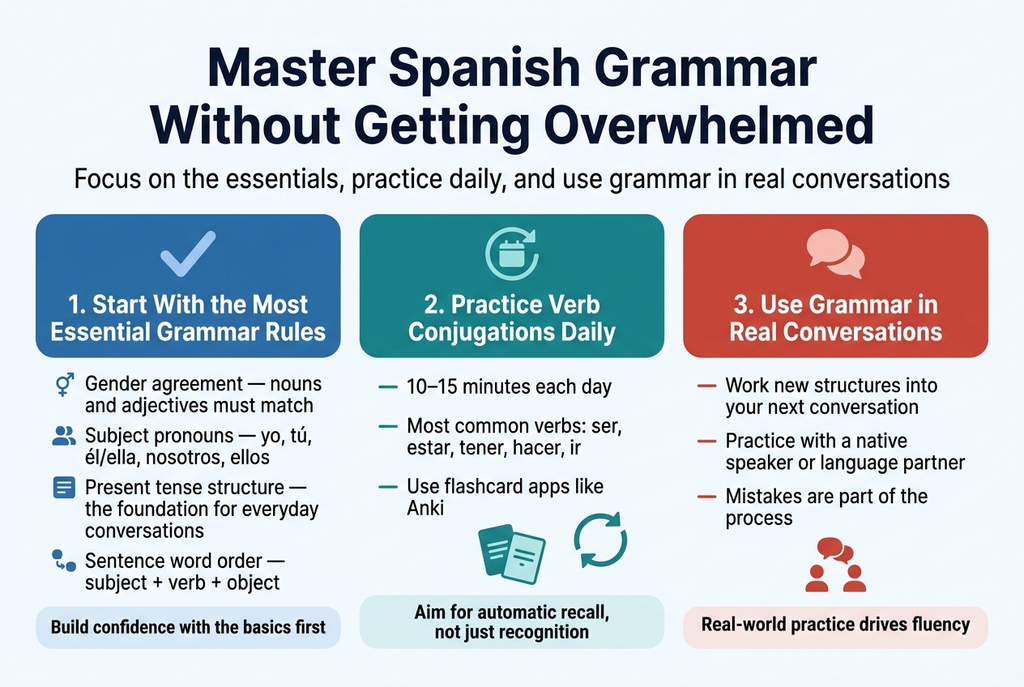
The Third Strategy To Become Fluent In Spanish Is To Master Spanish Grammar Without Getting Overwhelmed.
Start With the Most Essential Grammar Rules for Quick Wins
You don’t need to memorize every grammar rule to become fluent in Spanish. Focus on the high-impact basics first:
- Gender agreement – nouns are masculine or feminine, and adjectives must match
- Subject pronouns – yo, tú, él/ella, nosotros, ellos
- Present tense structure – your foundation for everyday conversations
- Sentence word order – generally subject + verb + object, similar to English
Tackle these core areas first, and you’ll handle most daily conversations with confidence.
Practice Verb Conjugations Daily to Build Automatic Recall
Verb conjugations trip up most learners, but daily repetition makes them second nature. Spend 10–15 minutes each day drilling the most common verbs — ser, estar, tener, hacer, ir. Use flashcard apps like Anki to reinforce recall without burnout. Your goal is to conjugate without thinking, not just recognize patterns on a page.
Use Grammar in Real Conversations to Reinforce Learning
Grammar rules only stick when you actually use them. After learning a new structure, work it into your next conversation with a native speaker or language partner. Making mistakes is part of the process — real-world practice is what ultimately drives you toward being fluent in Spanish.
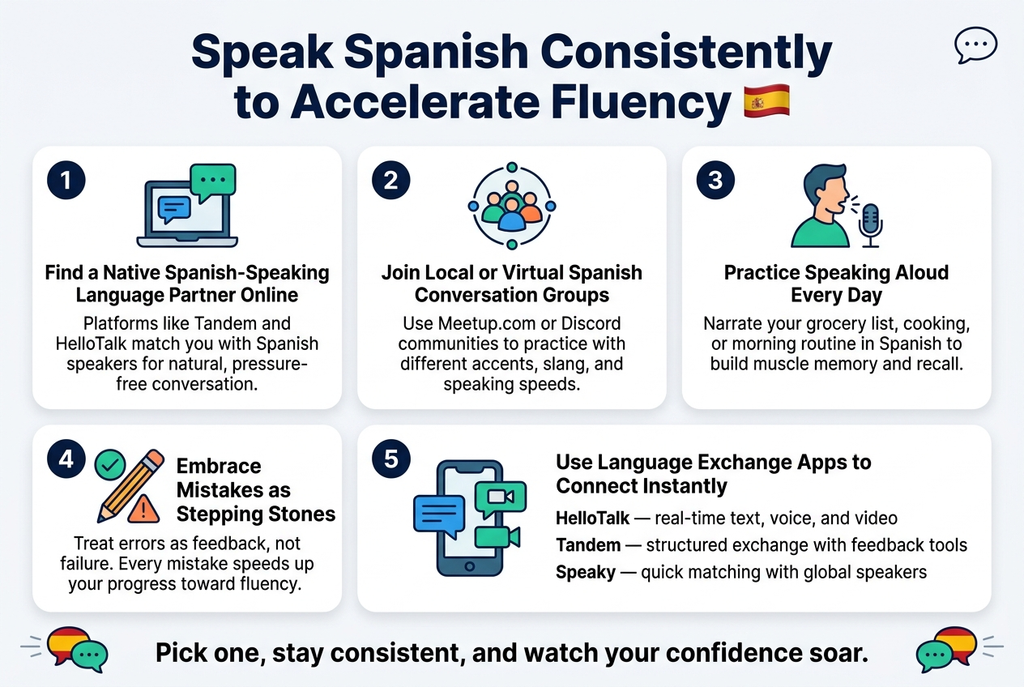
The Fourth Strategy To Become Fluent In Spanish Is By Speaking Spanish Consistently To Accelerate Fluency.
Find a Native Spanish-Speaking Language Partner Online
Connecting with a native speaker fast-tracks your fluency like nothing else. Platforms like Tandem and HelloTalk match you with Spanish speakers who want to learn your language in return — a win-win setup that keeps conversations natural and pressure-free.
Join Local or Virtual Spanish Conversation Groups
Search Meetup.com for Spanish conversation groups near you, or hop into Discord communities dedicated to language learners. Regular group conversations expose you to different accents, slang, and speaking speeds that textbooks simply can’t replicate.
Practice Speaking Aloud Every Day Even When Alone
Talk through your grocery list, narrate what you’re cooking, or describe your morning routine — in Spanish. This daily habit builds speaking muscle memory and helps your brain retrieve vocabulary faster when real conversations happen.
Embrace Mistakes as Stepping Stones to Faster Progress
Every error you make teaches you something a correct sentence never could. When you stumble over a word or use the wrong tense, treat it as feedback, not failure. The fastest path to becoming fluent in Spanish runs straight through your mistakes.
Use Language Exchange Apps to Connect With Spanish Speakers Instantly
- HelloTalk – real-time text, voice, and video
- Tandem – structured exchange with feedback tools
- Speaky – quick matching with global speakers
Pick one, stay consistent, and watch your confidence soar.
Wow, this resource here can help you with mastering Spanish right now!
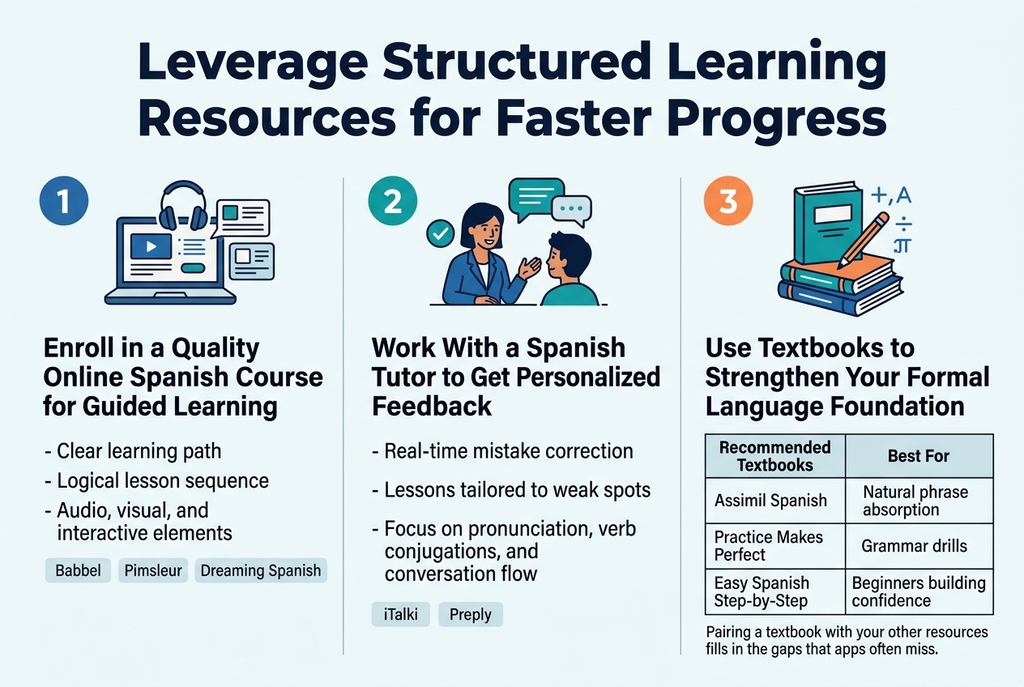
The Fifth Strategy To Become Fluent In Spanish Is By Leveraging Structured Learning Resources for Faster Progress.
Enroll in a Quality Online Spanish Course for Guided Learning
A structured online course gives your learning a clear path so you’re not just winging it. Platforms like Babbel, Pimsleur, or Dreaming Spanish walk you through lessons in a logical sequence, building your skills layer by layer. You get audio, visual, and interactive elements all in one place, which keeps things fresh and helps concepts actually stick.
Work With a Spanish Tutor to Get Personalized Feedback
Working with a tutor is one of the fastest ways to become fluent in Spanish because someone is actively correcting your mistakes in real time. Websites like iTalki or Preply connect you with native speakers and certified tutors who tailor lessons to your weak spots. You can focus on exactly what trips you up — whether that’s pronunciation, verb conjugations, or conversation flow.
Use Textbooks to Strengthen Your Formal Language Foundation
Textbooks might feel old-school, but they’re genuinely useful for understanding the structure behind the language.
| Recommended Textbooks | Best For |
|---|---|
| Assimil Spanish | Natural phrase absorption |
| Practice Makes Perfect | Grammar drills |
| Easy Spanish Step-by-Step | Beginners building confidence |
Pairing a textbook with your other resources fills in the gaps that apps often miss.
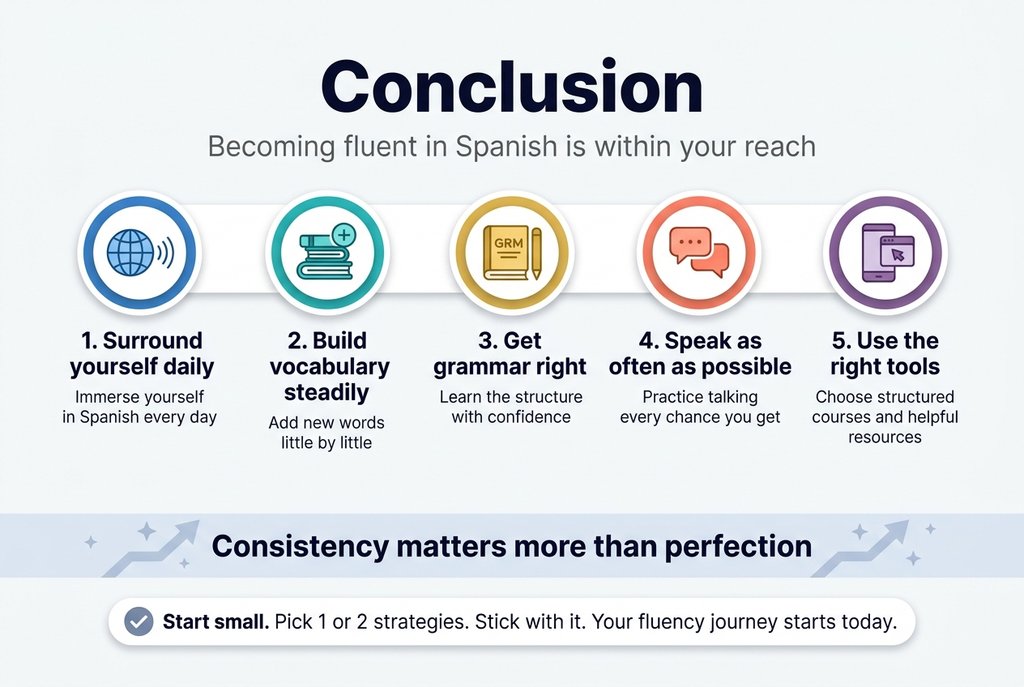
In Conclusion, becoming fluent in Spanish requires several effective strategies that help your memory recall vocabulary in context. By repeating these activities daily, you will become accustomed to them and learn how to communicate successfully in different situations.
Becoming fluent in Spanish is absolutely within your reach when you take the right approach. By surrounding yourself with the language every day, building your vocabulary steadily, getting a solid grip on grammar, speaking as often as possible, and using the right learning tools, you set yourself up for real, lasting progress. None of these steps require perfection — they just require consistency.
Start small if you need to. Pick one or two of these strategies and work them into your daily routine. Maybe that means switching your phone to Spanish, finding a conversation partner, or spending 20 minutes with a structured course each morning. Whatever you choose, stick with it. The more you show up, the faster you will find yourself thinking, speaking, and even dreaming in Spanish. Your fluency journey starts today — just take that first step.
As a form of inspiration to continue practicing your Spanish, I want to give you a copy of my Free e-book ” Mastering Spanish Conversations.” Please click the button below to grab your copy now!
Don’t forget to comment and share this blog post on your social media accounts!
If you are new to my blog, please feel free to check out the other recent posts.

Hi, my name is James! I am passionate about helping individuals master Spanish. My goal is to share practical strategies and methods for communicating in Spanish.
JAMES SIERRA