

Disclaimer: This post may include affiliate links. If you click one of these links, we may receive a small commission at no extra cost.
If you’ve ever signed up for Spanish learning classes and wondered why some teach you faster than others, you’re not alone. The secret usually comes down to how those classes are built from the ground up.
This is for anyone jumping into Spanish for the first time or switching programs after feeling stuck. Knowing what goes into a well-designed class helps you pick the right one and get more out of every session.
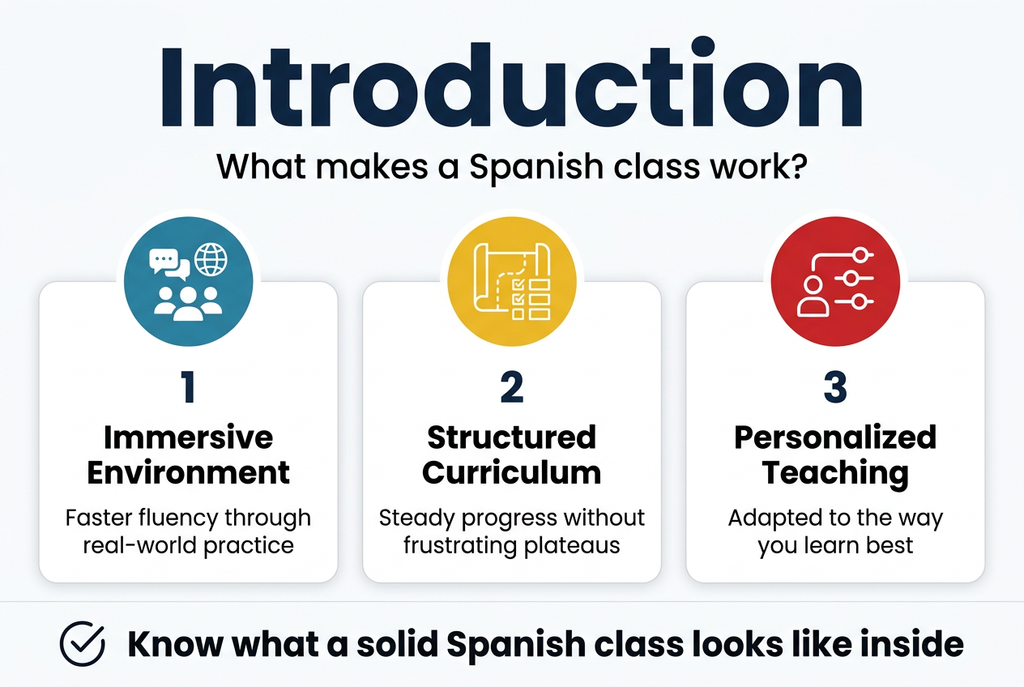
Here’s what you’ll learn: how immersive environments push your fluency faster than traditional methods, why a structured curriculum keeps you moving forward without hitting frustrating plateaus, and how personalized teaching adjusts to the way you learn best. By the end, you’ll have a clear picture of what a solid Spanish class actually looks like inside.
Now let’s find out: 3 ways how Spanish learning classes are designed.
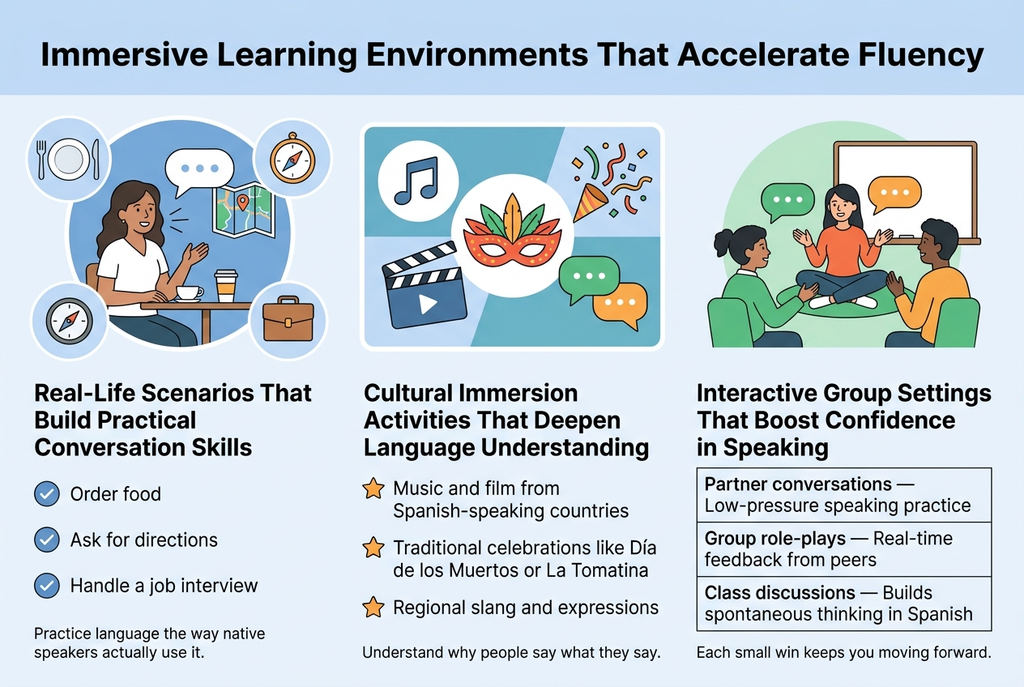
The first way how Spanish learning classes are designed are by immersive learning environments that accelerate fluency.
Real-Life Scenarios That Build Practical Conversation Skills
Spanish learning classes put you in situations that mirror everyday life — ordering food, asking for directions, or handling a job interview. You practice language the way native speakers actually use it, not just textbook phrases. This hands-on approach helps you retain vocabulary faster because you’re connecting words to real actions and emotions.
Cultural Immersion Activities That Deepen Language Understanding
Your classes go beyond grammar drills. You’ll explore:
- Music and film from Spanish-speaking countries
- Traditional celebrations like Día de los Muertos or La Tomatina
- Regional slang and expressions that textbooks often skip
Understanding why people say what they say makes the language click in a completely different way. You start seeing Spanish as a living, breathing part of a culture rather than a set of rules to memorize.
Interactive Group Settings That Boost Confidence in Speaking
Speaking in front of others feels uncomfortable at first — that’s completely normal. Group settings in Spanish learning classes give you a safe space to:
| Activity | Benefit |
|---|---|
| Partner conversations | Low-pressure speaking practice |
| Group role-plays | Real-time feedback from peers |
| Class discussions | Builds spontaneous thinking in Spanish |
You build confidence gradually, and each small win keeps pushing you forward.
To get more hands-on practice in Spanish, check out this great tool here!
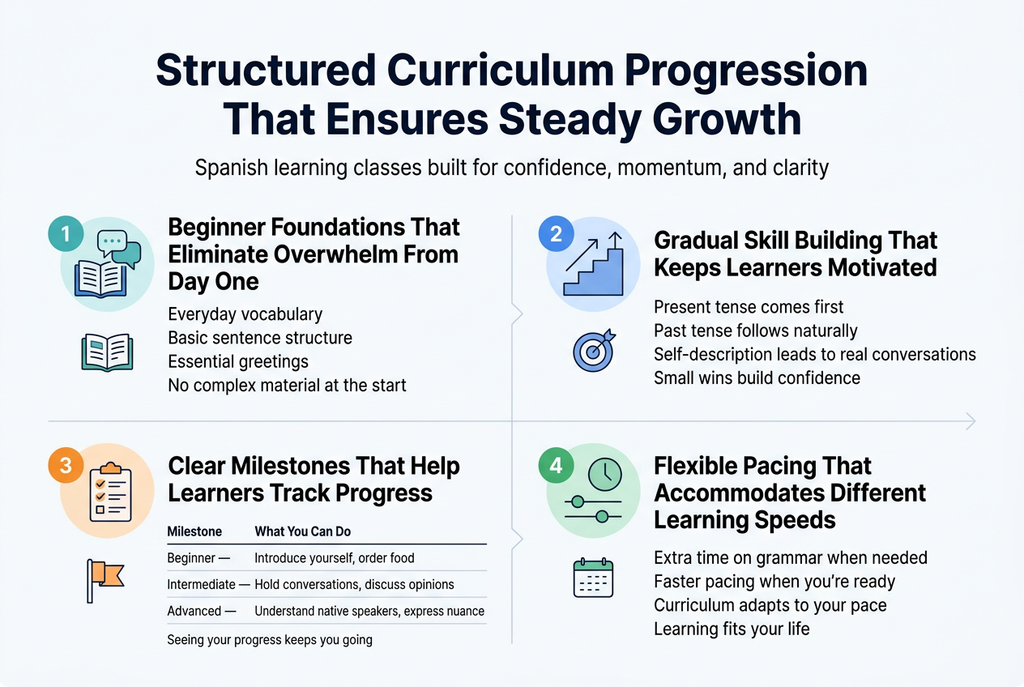
The second way how Spanish learning classes are designed is through structured curriculum progression that ensures steady growth.
Beginner Foundations That Eliminate Overwhelm From Day One
Spanish learning classes start by giving you only what you can handle. You learn everyday vocabulary, basic sentence structure, and essential greetings before anything complex enters the picture. This keeps your confidence intact from the very beginning.
Gradual Skill Building That Keeps Learners Motivated
Your skills stack on each other naturally. Once you’re comfortable with present tense, past tense follows. Once you can describe yourself, you start holding actual conversations. Each small win pushes you forward without feeling like a leap.
Clear Milestones That Help Learners Track Your Progress
You always know where you stand. Most Spanish learning classes break progress into clear checkpoints:
| Milestone | What You Can Do |
|---|---|
| Beginner | Introduce yourself, order food |
| Intermediate | Hold conversations, discuss opinions |
| Advanced | Understand native speakers, express nuance |
Seeing how far you’ve come keeps you going when things get tough.
Flexible Pacing That Accommodates Different Learning Speeds
Not everyone absorbs language at the same speed, and good classes respect that. If you need extra time on grammar, you get it. If you’re moving fast, your curriculum adjusts. Your learning journey is shaped around your life, not someone else’s timeline.
Go here to study Spanish and use this system to help you understand more in depth!
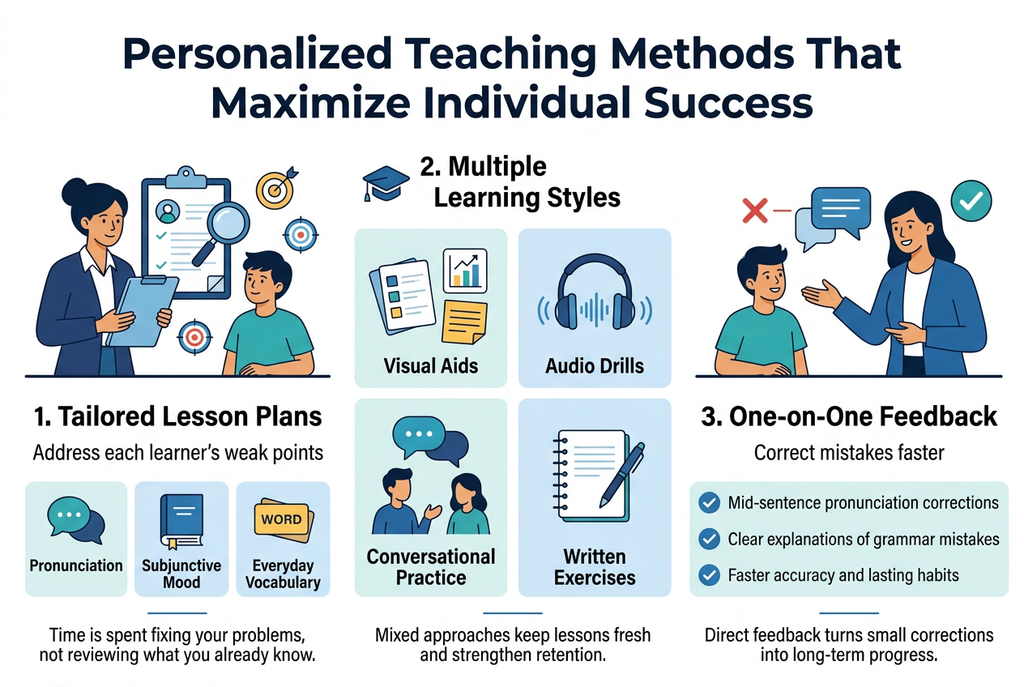
The third way how Spanish learning classes are designed is through personalized teaching methods that maximize individual success.
Tailored Lesson Plans That Address Each Learner’s Weak Points
In Spanish learning classes, your lessons aren’t built from a one-size-fits-all template. Instructors assess where you struggle—whether that’s rolling your R’s, mastering subjunctive mood, or building everyday vocabulary—and shape your plan around those gaps. Your time is spent fixing your problems, not reviewing things you already know.
Multiple Learning Styles Supported Through Varied Instructional Techniques
Good Spanish classes meet you where you are. Depending on how your brain absorbs information best, you might get:
- Visual aids – flashcards, charts, and color-coded grammar breakdowns
- Audio drills – listening exercises and pronunciation repetition
- Conversational practice – real dialogue scenarios that mirror everyday situations
- Written exercises – journaling, grammar worksheets, and storytelling prompts
Mixing these approaches keeps things fresh and makes retention stronger across different lesson types.
To start improving your Spanish faster, implement this resource right here!
One-on-One Feedback That Helps Learners Correct Mistakes Faster
Nothing speeds up your progress quite like direct, personalized feedback. When an instructor corrects your pronunciation mid-sentence or explains why a grammar rule tripped you up, you stop repeating the same errors. You build accuracy faster than you would studying alone. That back-and-forth exchange turns small corrections into lasting habits.
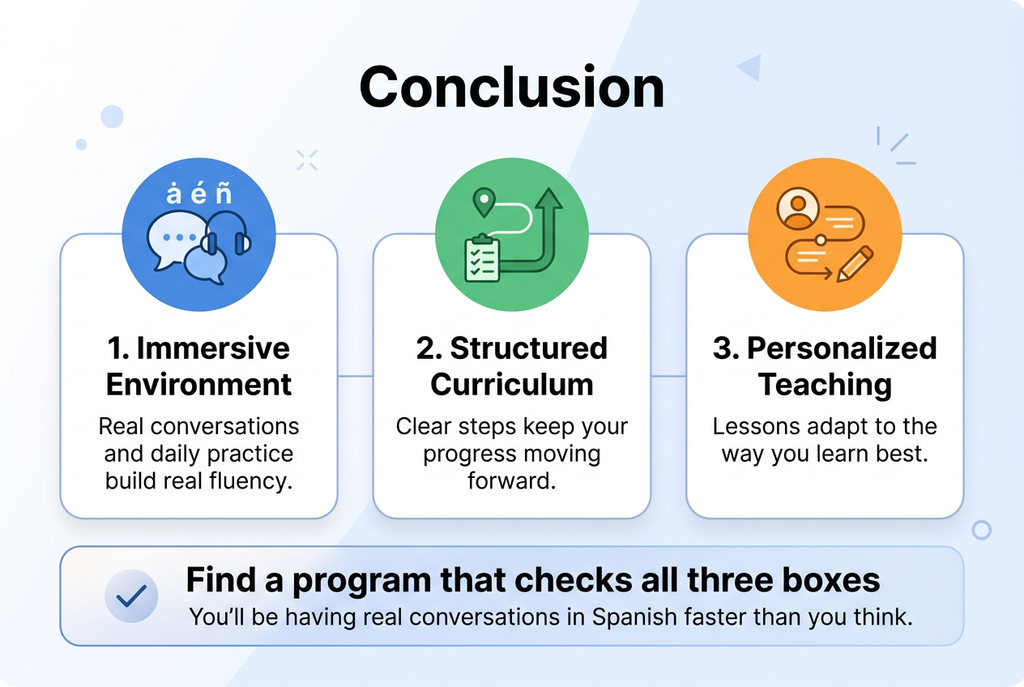
In conclusion, there are indeed 3 ways how Spanish learning classes are designed to provide you the best learning perspective. Each one reinforces your ability to improve your memory and build communication skills in the language.
Let’s quickly recap the overall outcome in depth now!
Spanish learning classes are built around three powerful ideas: immersive environments that push you toward real fluency, a structured curriculum that keeps your progress moving forward, and personalized teaching approaches that work with the way you learn best. When these elements come together, the classroom stops feeling like a chore and starts feeling like a space where you can actually grow and connect with the language on a deeper level.
If you’ve been on the fence about signing up for a Spanish class, now you have a clearer picture of what to expect and why the design behind these classes actually matters. Find a program that checks all three boxes, and you’ll be having real conversations in Spanish faster than you think.
To support you on your Spanish-learning journey, I want to give you a copy of my Free e-book, “Mastering Spanish Conversations.” To get your instant copy, please click the button below now!
Don’t forget to comment and share this blog post on your social media accounts!
If you are new to my blog, please feel free to check out the other recent posts.

Hi, my name is James! I am passionate about helping individuals master Spanish. My goal is to share practical strategies and methods for communicating in Spanish.
JAMES SIERRA